
Fostering Place-Based Ecological Literacy
Climate change and biodiversity loss are pressing issues requiring immediate action, yet it is still rare for business education to address the root causes of our ecological crisis (Mason et al, 2024). Ecological literacy (Orr, 1994) has begun to address this lacuna and empower the next generation of socio-ecologically conscious leaders. Yet recent research proposes a more central role for place in regenerative pedagogies to help address the profound disconnection in western thought between humans and the environments and communities that sustain us. Unfortunately, place-based ecological literacy (Woods et al, 2024) remains marginal and under-researched in management education.
This project addresses this gap by exploring how management educators might effectively practice experiential, community-based and contextual ecological learning to cultivate greater connectivity with(in) local contexts. Using co-created action research, we will develop a series of participatory, multi-stakeholder, interdisciplinary and inter-organisational workshops. These will explore how competencies such as critical, systems, futures and exploratory thinking can be fostered to support learners develop knowledge, skills, attitudes and imaginaries to drive positive change fit for uncertain futures. The project also considers how fostering place-based ecological literacy might, in turn, promote more responsible, regenerative management praxis.
We gratefully acknowledge the support of the British Academy of Management.
Workshop 1: Soil Sounds
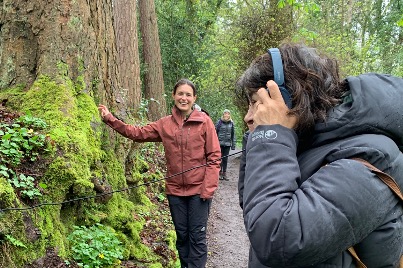
Leonardo da Vinci famously remarked that “we know more about the movement of celestial bodies than about the soil beneath our feet.” Despite its crucial importance for healthy ecosystems and food cultivation, soil remains one of the least understood and most neglected ecosystems today. As George Monbiot observes, this ignorance contributes to us treating this “most complex of all living systems … like dirt” (2022: 26).
This session explores how we might come to know soil more deeply by engaging with cutting‑edge developments in soil‑sound technology. Through an interactive, sensory‑based workshop, we invite participants to encounter the living voice of the Earth using biosonification tools that convert natural processes into sound. In collaboration with the Friends of Tangshutt Fields, and led by acoustics researcher Natasha Fell from Lancaster University, we will compare real‑time soil activity across different soil environments and discuss what these sonic signatures reveal about ecosystems, health, and human impact. Together, we will then consider how listening to soil transforms the ways in which we understand and relate to it.
The workshop aims to cultivate a more holistic understanding of living soil systems and to encourage a deeper sense of connection with the vibrant worlds beneath our feet.
Workshop 2: Fungal Networks
In recent years there has been a surge of popular and academic interest in fungi: organisms which plays a vital role for life on this planet but remain surprisingly underexplored. Scholars have argued that mycelial thinking challenges and complexifies dominant ways of thinking (Sheldrake, 2020) relating (van Dooren, 2016) and organising. Fungi open up possibilities for reimagining more sustainable modes of consumption and production (Stöckelová et al, 2023; Tsing, 2015), and for developing innovative responses to contemporary social and environmental challenges (Delvendahl et al, 2023).
Whilst educational implications of thinking-with and working-with fungi are beginning to be explored in other disciplines (Hardy, 2026; Kolb, 2025) this work remains under-developed in management education. This workshop will be an active, creative and thought-provoking space for participants interested in exploring the potential of mycelial thinking—literally, metaphorically, and experientially—to reimagine management education for a better world. Through expert input and hands-on working with mushroom cultivation, we will explore fungus as a tool for community building, climate action, regenerative world-building and social innovation.
The session has been organised in collaboration with FungAll, a Community Interest Company which is building a hyper-local, community-run food system at a neighbourhood level. We will also be joined by Kaydee Barker, a postgraduate researcher at the University of Manchester who studies soil ecology and biogeochemistry, with a focus on plant-fungal interactions.